Work Plan
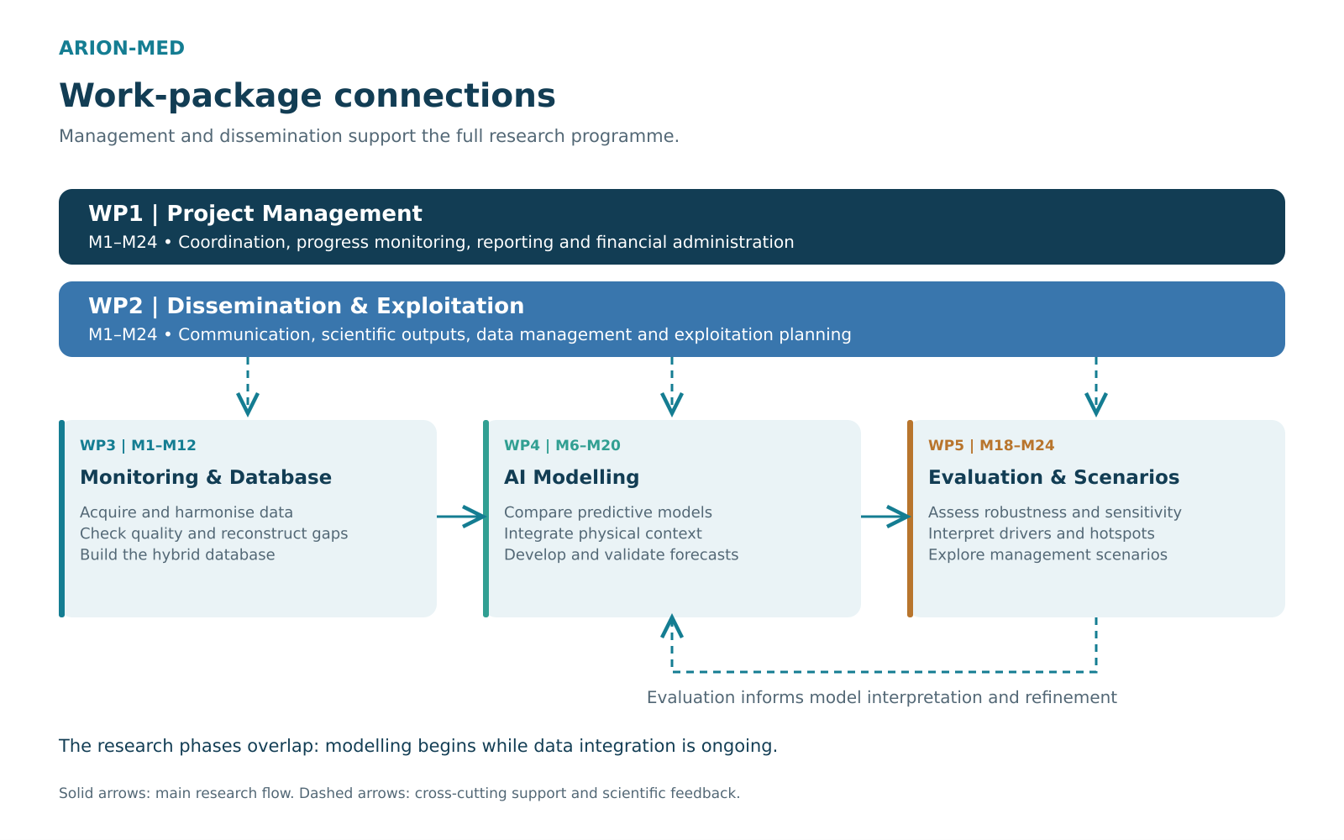
The work plan comprises five overlapping work packages over 24 months. Months below are measured from the official project start.
Work Package 1
Project Management
Months 1–24. WP1 ensures the effective scientific, administrative, and financial management of the project through the coordination of consortium activities, monitoring of milestones and timelines, and timely preparation of progress reports. It also promotes communication, data sharing, and scientific collaboration among project partners, DFMR, and regional institutions, while overseeing financial records, monitoring expenditures, and preparing required financial reports.
Work Package 2
Dissemination and Exploitation Activities
Months 1–24. WP2 promotes the project's visibility and impact by disseminating research outcomes through the project website, partner communication channels, scientific publications, conferences, and outreach activities. It coordinates scientific contributions and data sharing in accordance with applicable data-use agreements, while establishing arrangements for intellectual property protection and the exploitation of project results in collaboration with the RIF Knowledge Transfer Office.
Work Package 3
In-Situ Monitoring and Hybrid Environmental Database Development
Months 1–12. WP3 establishes a harmonized, documented, and modeling-ready environmental database by integrating complementary data sources. It brings together in situ physicochemical and fecal indicator bacteria (FIB) observations from Cyprus SubSea, DFMR, regional collaborators, and relevant European records, with satellite Earth Observation (EO) data, operational hydrodynamic products, and land-use/land-cover information, including CORINE Land Cover. The datasets are quality-checked, missing-data reconstruction methods are assessed, and the resulting information is cleaned, integrated, and fused into a unified hybrid database for subsequent environmental modeling.
Work Package 4
AI Modeling of Eutrophication and FIB Pollution
Months 6–20. WP4 develops and evaluates AI-based models to interpret and predict coastal water quality, focusing on eutrophication and fecal indicator bacteria (FIB) pollution. It investigates seasonal and time-lagged relationships, compares alternative AI architectures and input configurations, and explores integrating hydrodynamic information and transport-, dispersion-, and mixing-related physical constraints to improve model performance and reliability. The work also develops and evaluates a research forecasting and early-warning module targeting 24–72-hour predictions, validating its outputs against independent monitoring observations and examining potential patterns of pollution risk.
Work Package 5
Model Performance Evaluation, Sensitivity Analysis and Management Scenario Development
Months 18–24. WP5 evaluates the robustness and predictive performance of the developed models and translates their outputs into interpretable environmental insights to support coastal water-quality management. It quantifies the influence of environmental variables and anthropogenic pressures using explainable AI techniques, such as SHAP and permutation importance, and explores management and restoration scenarios to assess how changes in selected conditions or pressures may affect predicted water quality. The work also evaluates prediction accuracy and early-warning event-detection capabilities against monitoring records, identifying potential high-risk areas and indicators to inform monitoring and mitigation priorities.
