Our objectives
Integrate and quality-control in-situ measurements, microbial records, satellite observations, existing hydrodynamic outputs, land-use information and European bathing-water data.
Compare machine-learning and neural-network approaches for eutrophication indicators and fecal indicator bacteria (FIB), including physics-aware methods and research towards forecasts 24–72 hours ahead.
Assess influential environmental and human-related drivers, identify potentially vulnerable coastal areas, and develop evidence-based management and restoration scenarios.
Produce at least two open-access scientific publications and two international conference presentations, supported by joint analysis and scientific exchange across the Eastern Mediterranean.
Our approach
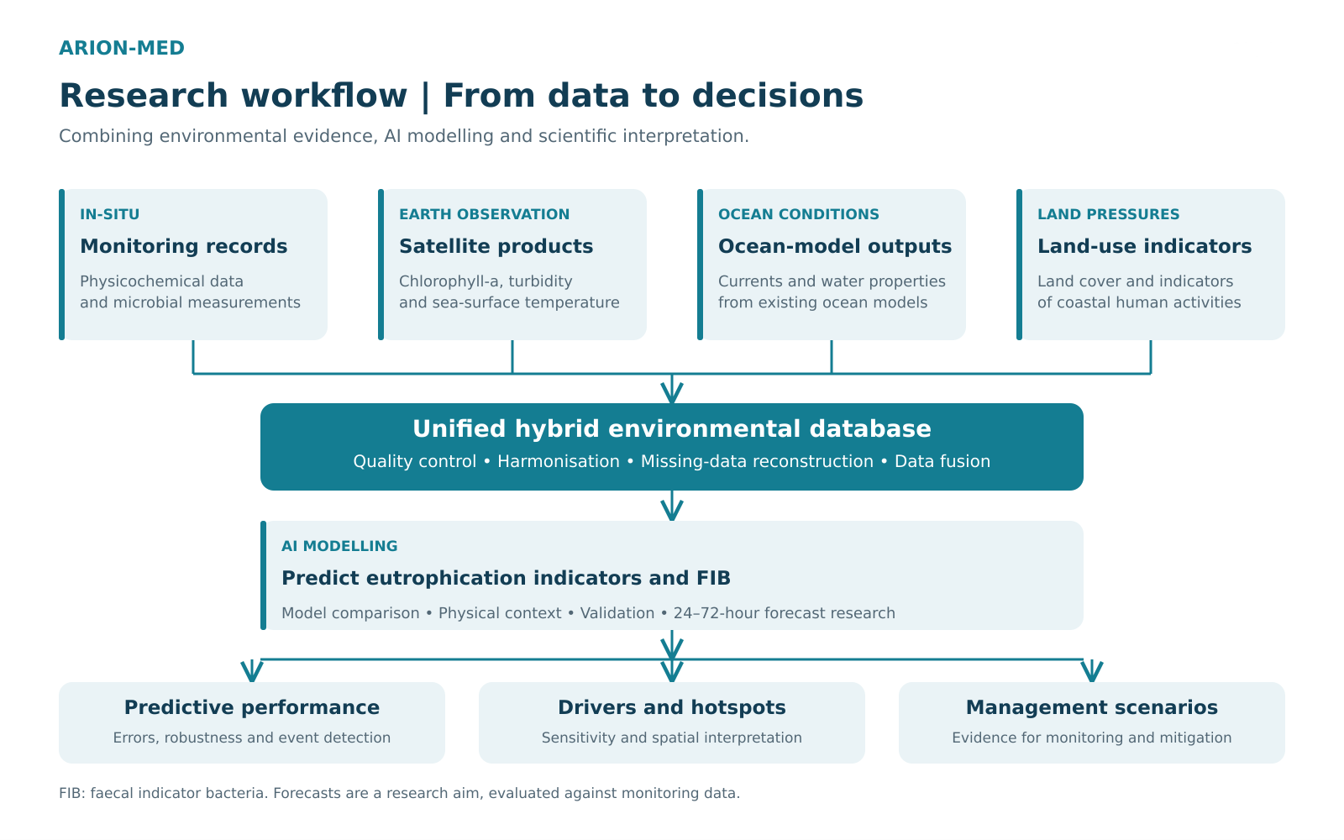
ARION-MED connects data acquisition, quality control, AI modeling and environmental interpretation in a single research workflow. Monitoring records are harmonized in space and time, with documented methods for handling inconsistencies and missing data. Seasonal patterns and time-lagged relationships inform model development.
The modeling framework compares methods such as Random Forest and XGBoost with neural network approaches, including LSTM, BiLSTM, and ConvLSTM. Existing hydrodynamic products provide information on currents and water properties, while physics-aware methods explore how transport and mixing can inform predictions. Validation examines prediction error, event detection, and performance across locations and time periods.
Research focus
The project addresses eutrophication indicators such as chlorophyll-a and turbidity, as well as microbial contamination, represented by FIB, including E. coli and enterococci. Cyprus is the main study setting; regional datasets support assessment of model robustness and transferability.
ARION-MED develops and validates research methods at TRL 2–5, providing a foundation for future early-warning and decision-support applications.
Impacts
ARION-MED aims to connect advances in environmental data integration and artificial intelligence with practical scientific evidence for coastal protection. Its expected benefits span research, environmental monitoring, society, and the blue economy.
Scientific and technological impact
The project will strengthen capacity to combine fragmented environmental records into a coherent modeling resource. Comparing conventional and advanced AI approaches, including physics-aware methods, will provide new evidence on how eutrophication indicators and microbial contamination can be predicted under Eastern Mediterranean conditions.
Documented validation and sensitivity analyses will help explain where models perform well, which inputs matter most, and what uncertainties require further investigation.
Environmental monitoring and management
Integrated analysis can support the identification of potentially vulnerable coastal areas and improve understanding of the pressures associated with water-quality deterioration. Management and restoration scenarios will explore how changes in nutrient inputs, land-based pressures and environmental conditions may influence predicted outcomes.
In collaboration with DFMR, these findings will provide evidence relevant to monitoring priorities and implementation of the Water Framework Directive, Marine Strategy Framework Directive and Bathing Water Directive.
Social and economic relevance
Improved understanding of microbial contamination and eutrophication can inform efforts to protect recreational waters and marine ecosystems. The research is relevant to tourism, aquaculture, and environmental services, which depend on coastal environmental quality. Cyprus SubSea will gain experience in integrated data interpretation and AI-assisted environmental assessment, supporting future innovation in its services.
Regional cooperation and future applications
Cross-regional testing and scientific exchange will strengthen cooperation among Cyprus and Eastern Mediterranean research institutions. Transferable data-processing and modeling methods can support future collaborative projects and the development of decision-support applications.
ARION-MED will evaluate early-warning potential through research forecasts and monitoring-based validation. Any future operational use will require further development and assessment.
